

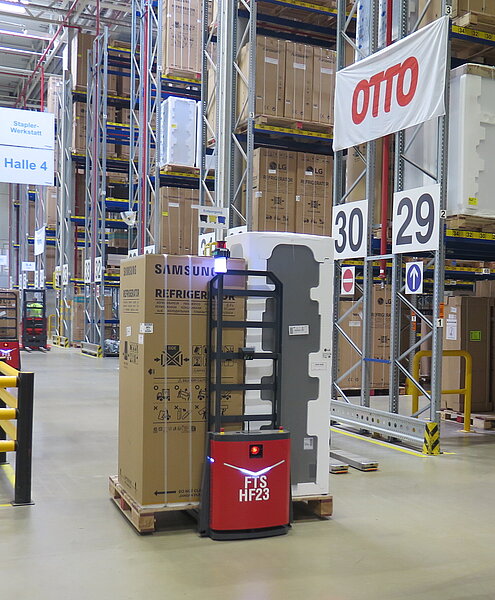
The site in North Rhine-Westphalia specializes in the logistical handling of large-volume items weighing more than 31.5 kilograms. These include primarily furniture, large electrical appliances such as washing machines and refrigerators, but also upholstered furniture and mattresses. The large items are mainly stored on shelves up to 12.40 meters high. Orders usually consist of several packages. These are mostly picked by hand at floor level onto large pallets. These loading aids are handed over at the logistics center to Hermes Einrichtungs Service, which then delivers the ordered goods using a two-man handling system. Until now, low-lift trucks operated by employees have primarily been used for handover to the sister company at the logistics center.
In the future, these vehicles will be supplemented by self-driving mobile robots from the Austrian manufacturer Melkus Mechatronic. They weigh 222 kilograms and can transport up to 1,200 kilograms of payload. Because they can carry many times their own weight, like ants, the devices are also called Ants at Hermes Fulfilment. The lifting height is 240 millimeters. The vehicles move autonomously at an average speed of 1.5 meters per second and navigate using laser scanners mounted on the mast, skids, and sides. To enable the AMRs to orient themselves to their surroundings, the building infrastructure was measured, mapped, and stored in a cloud-based control platform. Transport is coordinated via a control center.
Sensors ensure that the vehicles detect obstacles and swerve or brake in good time if there is not enough space to drive around them. "Safety is our top priority at the logistics center," says Thomas Saltenbrock. That is why employees are trained in how to interact with the mobile robots. Employees also have to get used to changed right-of-way rules: the self-driving load carriers always have priority – both over conventional industrial trucks and over employees who are on foot in the 100,000-square-meter logistics center. The internal traffic concept has been adapted accordingly.
For employees, the use of self-driving load carriers means a higher level of occupational safety. "There is less manual transport. The automated material flow ensures greater calm in the logistics processes because the robots travel at a consistently low speed," explains Thomas Saltenbrock. This also improves the efficiency of internal processes. Employees who previously carried out such transport tasks are now relieved of this burden and can take on other, more complex tasks in the logistics center in the future. "By using AMRs, we are creating a modern, motivating working environment with future prospects in the logistics sector. This is an important factor against the backdrop of demographic change, the noticeable labor shortage, and the rising retirement age," emphasizes Thomas Saltenbrock.
Hermes Fulfilment has already successfully integrated 23 battery-powered robots. Two more are to be added. Together, the devices will complete around 1,000 transports per day, covering a distance of around 30 kilometers. Around 20 percent of transports will continue to be carried out with conventional low-lift trucks in the future. Once the pilot phase at the Löhne logistics center has been completed, the robot solution will also be introduced at Hermes Fulfilment's other two-man handling site in Ansbach, Franconia.
About Hermes Fulfilment:
Hermes Fulfilment GmbH, headquartered in Hamburg and with locations in Haldensleben, Löhne, Ohrdruf, Ansbach, and Langenselbold, as well as in Poland, Czechia, Switzerland, and Italy, handles the entire shipping process chain for Otto Group retail companies and their platform partners. The company organizes warehousing (storage and packaging) and returns processing for a product range of around one million items. Hermes Fulfilment employs around 8,000 people and moves around 500 million items per year. Further information: www.hermes-fulfilment.de